The agent roles
A task is a series of agent runs on one agent/<task> branch. Each run has one role, and the role
fixes what the run may write and which models and tools it may call. Only two roles write: the tester
and the implementer. Every other role reads and reports.
Two GitHub Apps stand beside the agents. They are not agents and run no model: policy-bot posts a status on every agent pull request, and the merger App merges what the merge gate decided or a maintainer approved.
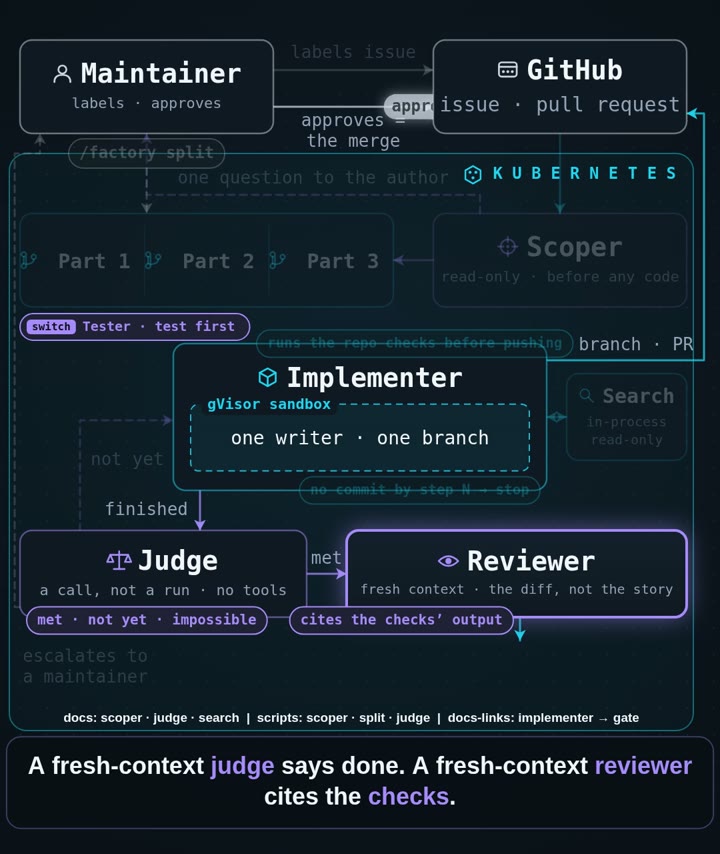
The roles
    flowchart TB
  subgraph shape["1 · Shape the task"]
    direction LR
    issue["Labelled issue"] --> scoper["Scoper"]
    scoper -->|"a question"| author(["Author"])
    scoper -.->|"hard issue"| split["Split proposal"]
    scoper -->|"bounded task<br/>+ checks"| tester["Tester<br/>failing test contract"]
  end
  subgraph build["2 · Build"]
    direction LR
    impl["Implementer<br/>search tool · repo checks"] --> judge{"Completion<br/>judge"}
    judge -->|"not_yet"| impl
    judge -->|"met"| reviewer["Reviewer<br/>other tier"]
    judge -->|"impossible"| esc(["Maintainer"])
    impl -->|"opens"| pr["Pull request"]
    reviewer -->|"verdict"| pr
  end
  subgraph merge["3 · Merge"]
    direction LR
    gate{"Merge gate"} -->|"live class,<br/>every check holds"| merger["Merger App"]
    gate -->|"hand-off:<br/>one action"| human(["Maintainer"])
    human -->|"approves<br/>the head"| merger
  end
  shape -->|"tester → implementer"| build
  build -->|"pull request → merge gate"| merge
The implementer runs on every task, and the reviewer on almost every one: the task’s template decides
(pair is the implementer and a reviewer). The scoper, tester, search and judge are switched on per
class: a class is a kind of change the factory recognises, such as “link fixes” or “scripts”. A role
that is off for a class is skipped.
Every role in one table
| Role | What it does | Writes? |
|---|---|---|
| Scoper | Reads the issue and turns it into a bounded task with acceptance checks. If one thing is unclear, it asks the author one question instead (what you do then) | No |
| Splitter | Part of the scoper: proposes splitting a hard issue into smaller parts. A maintainer approves the split; the parts then run one at a time | No |
| Tester | Writes tests that fail on the current code. They become the contract the implementer works to, and the implementer may not change them | Tests only |
| Implementer | Writes the change on the task’s branch, runs the repository’s own checks and opens the pull request. It runs again for a review’s changes or a red CI | Code |
| Search | A read-only helper the implementer can ask a question about the repository | No |
| Completion judge | A single model call with a fresh context: is the change done against its acceptance checks? not_yet sends the implementer back; impossible escalates to you | No |
| Reviewer | Reviews the pull request with a different model from the implementer’s, and posts a verdict. On a class that may merge by itself, the gate needs its approval; otherwise its verdict is advice for you | No |
| Triager | Investigates an alert handed over by RunLore, the platform’s incident agent, and proposes a public issue, which a maintainer publishes. The scoper is a triager run too | No |
| policy-bot (an App) | Posts the policy-bot: main status on every push; dismisses an approval when the head moves | No |
| Merger App (an App) | Merges the commit the gate decided, or the one a maintainer approved; opens the revert of a factory merge | Merges only |
When each role starts and how it ends: run endings. Each task has a data class: public (an open repository’s work) or internal (private data, which only reaches approved providers). Example (the reference host, cloud-native-ref): every role uses GLM-5.3 for public work and Claude Opus 5.5 for internal work; the judge uses their light versions.
What each role may call
For platform owners. Each role has one capability profile per data class, in
infrastructure/base/agent-gateway/profiles/<role>.<public|internal>.yaml. They compile into the
gateway’s rules.
| A profile declares | Enforced by |
|---|---|
models: the aliases the role may name. Only public profiles list the providers | The gateway answers 403 to any other alias; the factory refuses an internal run that names a public-only alias |
tools: the MCP tools and arguments it may use. The reviewer cannot read the implementer’s transcript; no tool reads a Secret | The gateway, before the call reaches the MCP server |
| One model per run | The identity proxy pins every call, the judge’s too, to the run’s alias |
To change what a role may call, edit its profile, run scripts/ci/gen-capabilities.py with --write, and let
task check prove the compiled rules match.
A task’s life
You see a task’s phase in its room (the task’s live log), with the maku status <room> command and in
kubectl get tasks. The diagram keeps
the main path; Maku’s full diagram
has every transition.
    stateDiagram-v2
  [*] --> Received: factory/ready, Slack, API, RunLore
  Received --> Implementing: triaged
  Implementing --> Escalated: the run cannot finish
  Escalated --> Implementing: /factory retry
  Implementing --> Reviewing: PR opened, judge met
  Reviewing --> Implementing: changes
  Reviewing --> AwaitingCI: reviewer approves
  AwaitingCI --> AutoMerging: live class, every check holds
  AwaitingCI --> AwaitingHuman: hand-off
  AwaitingHuman --> Done: approved merge
  AutoMerging --> Verifying: merged
  Verifying --> Done: main green
  Verifying --> Reverted: main red
  Done --> [*]
  Reverted --> [*]
What the diagram leaves out:
- Intake can reject a task: its issue is too long, or the day’s task cap is reached.
- A run that cannot finish escalates to you (a question, a split, a spent budget);
/factory retryresumes it. - After a merge by the gate, the task checks that
mainstays green, and reverts if it turns red. A merge you approved is never reverted automatically. factory/stopor the kill switch stops any open task.